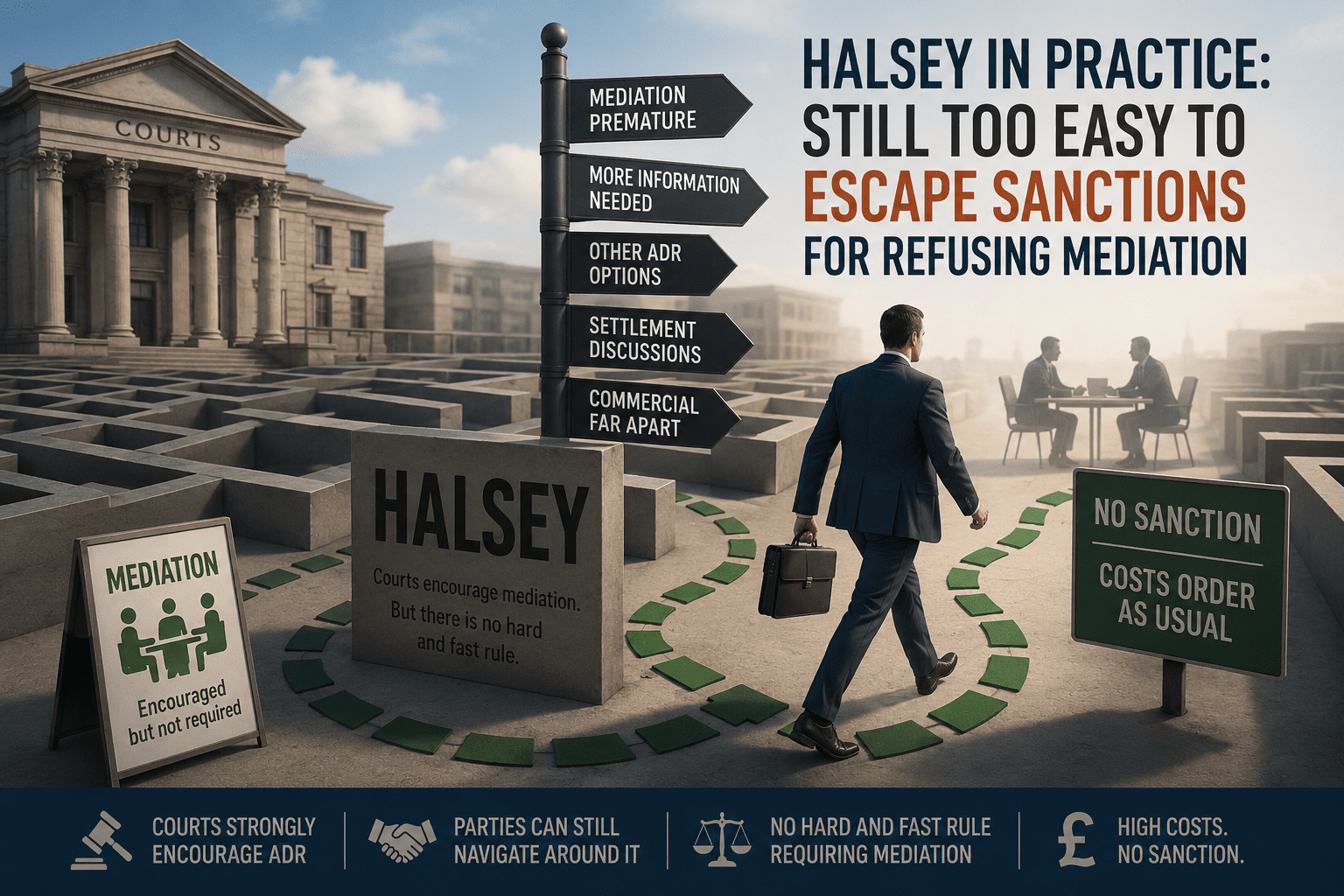
Halsey in practice — the courts encourage mediation, but it is still often possible to avoid sanctions for refusing it
The decision in MJS Projects (March) Ltd v RPS Consulting Services Ltd
Neutral Citation Number: [2026] EWHC 884 (TCC)
Case No: HT-2022-LDS-000011
is an important reminder that, despite increasingly strong judicial encouragement of ADR, it can still be surprisingly difficult to obtain a costs sanction against a party who refuses to mediate.
From a mediator’s perspective, the judgment may be viewed as slightly disappointing. The court repeated the familiar authorities emphasising that cases unsuitable for mediation are “rare”, but the practical outcome demonstrates that parties can still avoid sanctions if they are able to construct a reasoned forensic justification for declining mediation.
The dispute concerned alleged negligent design and construction issues relating to a container park near Felixstowe Port. The claim, worth around £400,000 to £500,000, ultimately failed after trial. The claimant then argued that the successful defendant should be deprived of its costs because it had repeatedly refused mediation.
The claimant relied heavily upon the principles in Halsey v Milton Keynes General NHS Trust [2004] 1 WLR 3002, pointing out that:
- mediation had been proposed several times;
- the defendant’s reasons for refusing mediation appeared to shift over time;
- technical construction and professional negligence disputes are routinely mediated successfully;
- mediation could have avoided substantial litigation costs.
The claimant also pointed out that each side had budgeted approximately £25,000 for mediation or ADR costs, meaning the total anticipated mediation spend was around £50,000.
Despite this, the court rejected the argument that the refusal to mediate was unreasonable.
HHJ Kelly accepted that mediation had indeed been proposed on multiple occasions and that the defendant had declined to engage in mediation itself. However, the court considered the wider litigation context to be critical.
The defendant had:
- consistently raised workmanship and causation issues;
- provided calculations supporting its position;
- sought disclosure of the claimant’s expert evidence, even on a without prejudice basis;
- made settlement offers;
- proposed other forms of ADR and commercial discussions.
The claimant, by contrast, had not meaningfully engaged with the workmanship allegations and had not provided its expert report prior to proceedings or mediation discussions.
The court therefore held that the defendant’s conduct was not an unreasonable refusal to engage in ADR. Instead, it was viewed as a reasoned position that meaningful mediation could not take place until the defendant properly understood the expert case it was facing.
The judge also accepted that the cost of mediation was significant. A potential mediation spend of around £50,000 overall was not insignificant in a dispute with a net value of approximately £324,000.
The familiar Halsey factors were analysed:
- the nature of the dispute;
- the merits;
- other settlement attempts;
- proportionality of ADR costs;
- delay/prejudice;
- prospects of success.
Importantly, the court held that mediation did not have reasonable prospects of success in circumstances where:
- the parties remained commercially far apart;
- workmanship issues had not been addressed properly by the claimant;
- the claimant’s expert evidence had not been meaningfully shared or explained.
The result was the usual order that the unsuccessful claimant pay the defendant’s costs on the standard basis.
From a mediation perspective, the case demonstrates a continuing reality in litigation practice: although courts strongly encourage ADR, Halsey remains a discretionary and fact-sensitive exercise rather than a hard-edged rule compelling mediation.
Parties can still often avoid sanctions if they:
- avoid an outright blanket refusal;
- say mediation is premature rather than inappropriate;
- continue to suggest other forms of ADR;
- maintain that further information is required first;
- make some form of settlement offer.
In practical terms, this means that sophisticated litigants can frequently navigate around the risk of a mediation costs sanction provided their refusal is carefully framed.
The decision therefore illustrates the continuing tension in modern civil litigation. The courts repeatedly emphasise the importance of ADR and the overriding objective. Yet, in practice, there remains no automatic or predictable penalty for refusing mediation, even in high-value commercial disputes where enormous costs are ultimately incurred.
The judgment may therefore fuel continuing debate as to whether the current post-Halsey framework goes far enough in genuinely incentivising early mediation and meaningful ADR engagement.
At ProMediate, we continue firmly to believe that early mediation remains one of the most effective ways of controlling litigation risk, legal spend and commercial uncertainty. Even where parties believe they have a strong case, mediation can narrow issues, improve understanding of expert evidence, preserve commercial relationships and avoid the enormous financial and management costs associated with trial.
For those involved in commercial, professional negligence, construction or other substantial disputes, early engagement with ADR may still produce outcomes which litigation itself cannot achieve.
To discuss arranging a mediation through ProMediate (UK) Limited, please feel free to get in touch.