
The cost of disputing an inheritance
Published by Peter Causton
When a Will Dispute Consumes the Inheritance: The Importance of Mediation in Probate Litigation
A recent report by The Independent highlights yet another example of how family disputes over wills and inheritances can escalate into financially and emotionally devastating litigation.
The article concerned a challenge to a will made by Peggy Dalton, where the court reportedly found that dementia meant she lacked the mental capacity to make a valid will. As a result, the challenged will failed.
Importantly, despite some of the dramatic reporting language often used in the media, this was not a dispute over some vast aristocratic fortune. The estate appears to have been worth approximately £600,000 in total — essentially the sort of relatively ordinary family estate that can easily arise where a parent owns a house in modern Britain.
The claimant’s entitlement was therefore not a £600,000 judgment or “fortune”, but approximately one-third of the estate.
Equally striking, however, is the reported costs position. The unsuccessful party was apparently ordered to pay legal costs said to be around £190,000. If their own entitlement under the estate was itself only around £200,000, it becomes painfully obvious what the litigation may have achieved in practical terms: the likely destruction of almost the entirety of their inheritance through legal costs.
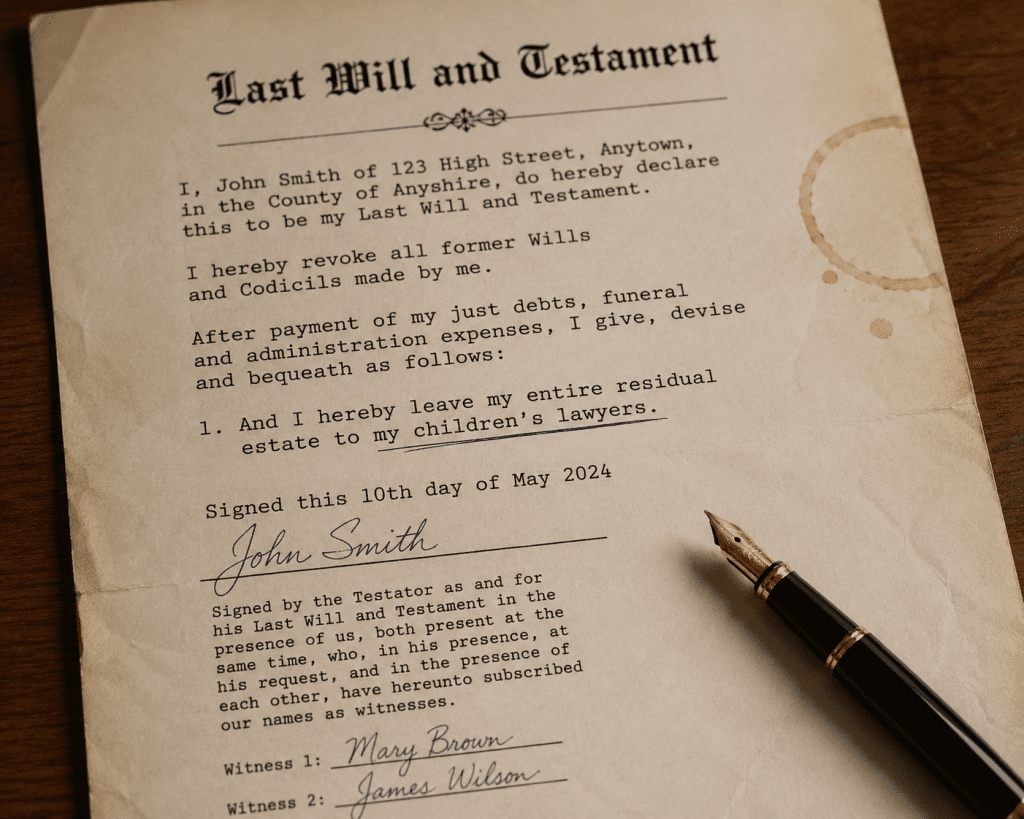
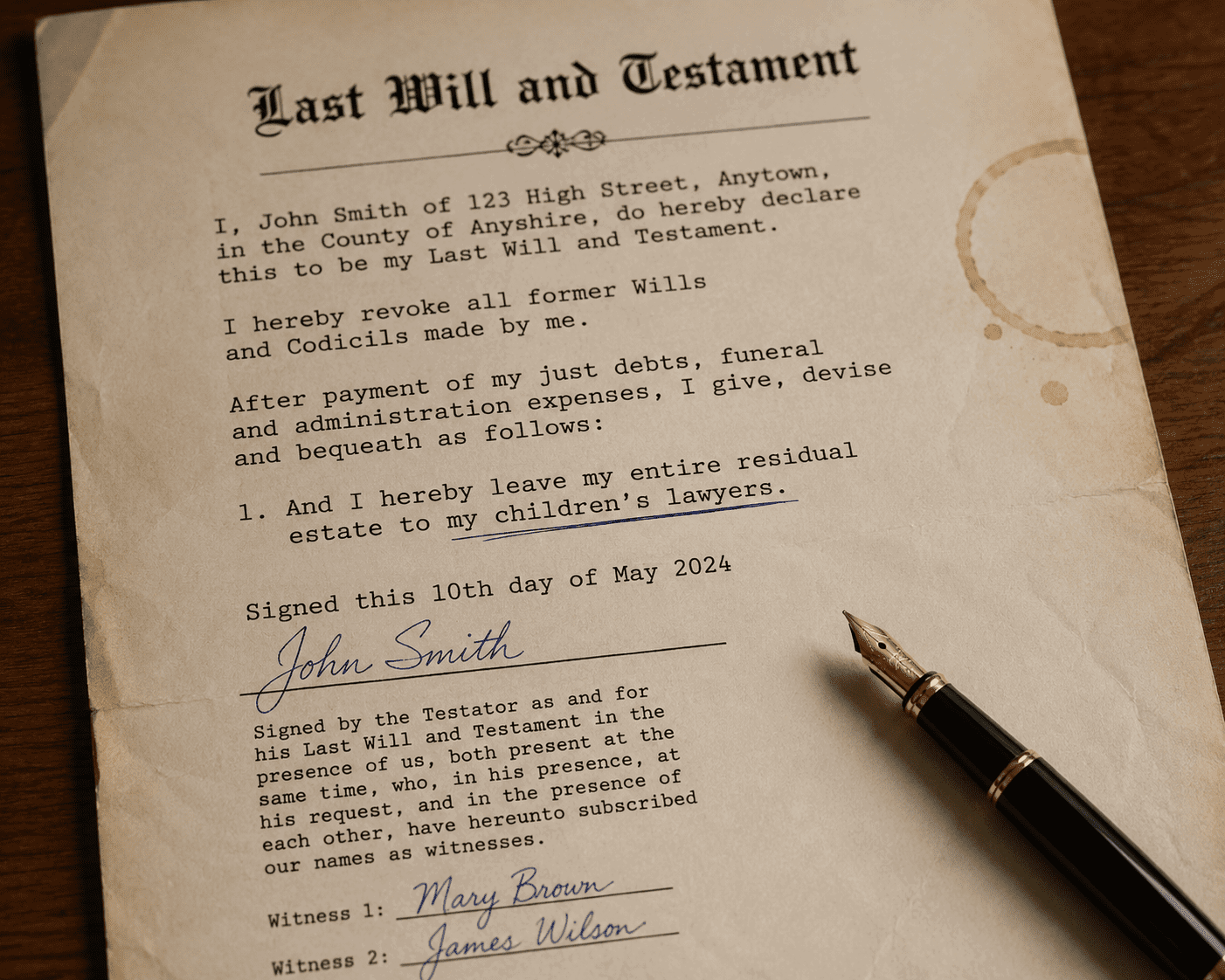
There is an old legal adage that a badly prepared or badly disputed will can result in a person leaving their estate not to their family, but to the lawyers. Whilst perhaps slightly unfair to the legal profession, cases such as this demonstrate why careful drafting, sensible advice, and early dispute resolution are so important.
Probate Litigation: Emotionally Difficult and Financially Dangerous
Will disputes are among the most emotionally difficult forms of litigation dealt with by the courts.
Unlike ordinary commercial disputes, probate claims often involve:
- grief;
- family breakdown;
- allegations of manipulation;
- accusations of dishonesty;
- disputes about dementia and vulnerability;
- sibling resentment dating back years or decades; and
- competing beliefs about what the deceased “really wanted”.
Very often, parties are not simply litigating about money. They are litigating about fairness, recognition, perceived betrayal, and family history.
Unfortunately, that emotional dimension can sometimes obscure the financial realities.
The Economics of Contesting a Will
Many people are genuinely shocked by the cost of contentious probate litigation.
Disputes involving:
- medical records;
- expert evidence on testamentary capacity;
- allegations of undue influence;
- disclosure disputes;
- witness evidence from family members; and
- multi-day trials
can rapidly generate legal costs running into tens or hundreds of thousands of pounds.
The uncomfortable reality is that ordinary middle-class estates — often consisting largely of a house — can be consumed by the legal process itself.
Even successful parties may find that the estate available for distribution has been heavily depleted by costs.
For unsuccessful parties, the consequences can be devastating because the usual civil litigation rule generally applies: the loser is often ordered to contribute substantially to the winner’s legal costs.
That means people can quite literally litigate away their inheritance.
Grounds for Challenging a Will
There are, of course, perfectly legitimate reasons to challenge a will.
Common grounds include:
- lack of testamentary capacity;
- undue influence;
- want of knowledge and approval;
- fraud or forgery;
- failure to comply with the formalities required by the Wills Act 1837; and
- claims under the Inheritance (Provision for Family and Dependants) Act 1975.
Some cases genuinely require court intervention.
However, probate litigation is highly fact-sensitive and inherently risky. A case that initially appears morally compelling may encounter significant evidential difficulties. Conversely, a seemingly robust defence can collapse once medical evidence and witness testimony are scrutinised.
Why Mediation Matters
This is one reason why mediation can be so valuable in contentious probate disputes.
Mediation allows parties to:
- assess litigation risk realistically;
- explore settlement before costs escalate;
- preserve family relationships where possible;
- maintain confidentiality; and
- reach practical solutions unavailable through a court judgment.
Unlike a trial, mediation is not restricted to a simple winner/loser outcome.
Parties can agree:
- adjusted distributions;
- deferred payments;
- property arrangements;
- retention of sentimental items;
- tax-efficient restructuring; or
- other pragmatic compromises tailored to the family’s circumstances.
Importantly, mediation also allows parties to retain a degree of control over the outcome, rather than handing that decision entirely to a judge after substantial legal costs have already been incurred.
The Human Cost
Beyond the financial consequences lies another issue entirely: emotional exhaustion.
Contested probate litigation frequently involves years of hostility, allegations against close relatives, painful scrutiny of a deceased parent’s final years, and witness statements attacking family members.
Even where parties technically “win”, many emerge from the process emotionally and financially damaged.
Conclusion
The recent case reported by The Independent is a reminder that inheritance disputes are not confined to the super-rich. Increasingly, entirely ordinary family estates can generate extraordinary legal costs.
Sometimes the real victor in probate litigation is neither side, but the scale of the costs incurred.
Mediation will not resolve every dispute and some cases genuinely require judicial determination. However, early and realistic engagement in alternative dispute resolution can often preserve not only money, but also relationships, dignity, and emotional wellbeing.
Before commencing heavily contested probate proceedings, parties should carefully consider not only whether they can challenge a will — but whether they can realistically afford the consequences of doing so.

Peter Causton barrister and mediator