
The government has issued a consultation on whether the UK should sign the Singapore mediation convention.
I previously reported that It provides commercial disputants with the opportunity of mediating and being able to enforce a settlement agreement abroad without a Court order in the UK. Parties should now be able to mediate international disputes online and can be confident that agreements reached can be enforced. Mediation therefore becomes a viable option for dispute resolution on a par with litigation and arbitration. Parties will no longer need to prove breach of contract if a party does not comply with the terms of a settlement. Instead of first obtaining a judgment or award for breach of contract, the Singapore Mediation Convention will allow the enforcing party to go directly to a court in the country where enforcement is sought. That court will then enforce the settlement agreement, unless one of the limited grounds for refusing enforcement set out in the Singapore Mediation Convention applies. In an international context, obtaining a court judgment and enforcing it in a foreign jurisdiction can be very difficult and time consuming.
The consultation paper stresses the growing importance of mediation.
1.1) International trade is worth over £1tn to the UK Economy[footnote 1], and therefore it is crucial that UK businesses, big and small, continue to have the confidence to enter into cross-border contracts, investment relationships and to operate across borders in the knowledge that there are effective mechanisms in place to settle disputes as and when they arise.
1.2) The mediation sector in the UK has grown considerably in the last 15-20 years, with the sector estimated to be worth £17.5bn in 2020[footnote 2], as businesses look for more cost‑effective methods of resolving disputes outside of the traditional routes of court‑based litigation and arbitration. Mediation is an important means of resolving cross‑border disputes, by enabling the disputing parties to reach a suitable and mutually acceptable resolution themselves, without having to go to court, saving valuable time and money. It is a process which the Government considers ought to be integral to the Justice system, and it is estimated that mediation can save businesses around £4.6 billion per year in management time, relationships, productivity and legal fees[footnote 3].
1.3) The Singapore Convention on Mediation aims to provide a harmonised framework to enable parties seeking to enforce a cross-border commercial settlement agreement to apply directly to a Competent Authority (usually a Court) for the enforcement of that agreement.
1.4) The UK is already regarded as an international seat for arbitration and the Government is keen to understand whether that reputation, as well our reputation as a preferred seat for other forms of international dispute resolution, would be further strengthened by making it the same for mediation.
1.5) The Ministry of Justice conducted a focused, limited and informal consultation in September 2019, on whether the UK should become party to this Convention. Further information on this earlier consultation can be found at Chapter 4 of this consultation. Responses were broadly favourable with stakeholder feedback indicating that joining the Convention would raise the profile of mediation internationally and maintain the UK as an attractive dispute resolution hub. The Government also indicated that it was considering joining this Convention during the passage of the Private International Law (Implementation of Agreements) Act 2020, and that it could be implemented using the powers in that Bill, subject to stakeholder consultation.
1.6) The Convention may also present opportunities to establish new relationships in the Indo-Pacific, Middle East and Africa, as well as strengthening existing relationships with parties to the Convention, many of whom are members of the Hague Conference on Private International Law. This would align with the Government’s Integrated Review of 16 March 2021, which outlines its vision for the UK’s role in the world over the next decade and the action that will be taken to 2025. It is noted that several countries mentioned in the Integrated Review are already signatories to the Singapore Convention, including 18 Commonwealth nations with senior Commonwealth leaders continuing to encourage their members to sign the Convention, as well as key UK trading partners USA, China and India.
1.7) However, as part of the Government’s decision-making process about whether to become Party to this Convention it is important to obtain a wide range of views, especially from those who have first-hand experience of mediation law and practices in the UK, what works well and where improvements are required. For this reason, we are particularly keen to hear the views of any person or group in the UK with expertise or interest in mediation or the dispute resolution sector more generally, businesses which operate internationally and trade organisations with an international element. This may include (but is not limited to) legal professionals, academics, or civil society groups / charities.
I did predict that the UK would sign up to the convention. I agree with the benefits identified in the consultation:
“Some of the suggested benefits of mediation and the Singapore Convention that arose in that consultation are summarised as follows:
- The Convention will provide reassurance that a mediated outcome will have the same protection that international arbitral awards have, under the New York Convention 1958 on arbitration, namely that they will be readily enforceable in different jurisdictions.
- It may reduce frustration amongst mediators, who conduct numerous successful cross-border mediations without enforcement issues arising, but nonetheless face the reality that parties are reluctant to mediate due to worries over enforcement across different jurisdictions.
- Whilst it is possible for a mediation agreement to form part of an arbitration award, for example where an Arbitration-Mediation-Arbitration (Arb-Med-Arb) procedure is available, this procedure is not universally available. A summary procedure for the enforcement of mediated agreements is therefore generally desired by the commercial community.
- Endorsing the Convention will help to uphold the UK’s worldwide reputation for being at the centre of the commercial dispute resolution business. The UK risks losing out if, while still practically having an effective framework for mediation and enforcement of settlement agreements, it is not perceived to be backed up by the international legal framework which the Singapore Convention offers.
- Government policy for at least the last 20 years, since the Lord Woolf Civil Justice Reforms[footnote 5], has been to promote dispute resolution methods, particularly mediation, for domestic cases and so it would be inconsistent to adopt a different approach to international disputes. Ratification would signal the UK’s commitment to all forms of dispute resolution.
- The Convention would provide for more robust enforcement or clarification in the minority of cases where changed circumstances or new information means that a party may seek to extricate itself from, or to enforce, an agreement that has been apparently entered into freely.
- Evidence suggests that arbitration is no longer a quicker and more efficient alternative to litigation in commercial cases. Mediation has increased in popularity, as it can take place before and during the course of arbitration proceedings.
4.2) With regards to the last point, it is recognised that the Singapore Convention will not apply to International Mediated Settlement Agreements reached through hybrid proceedings, such as during the course of court proceedings or arbitration. However, the Convention may encourage more parties to rely solely on mediation proceedings to resolve their dispute, rather than seeking to initiate arbitration proceedings, during the course of which a mediation may take place as part of a longer and potentially more costly process.”
Responses are requested by April 2022 which is quite a short window.
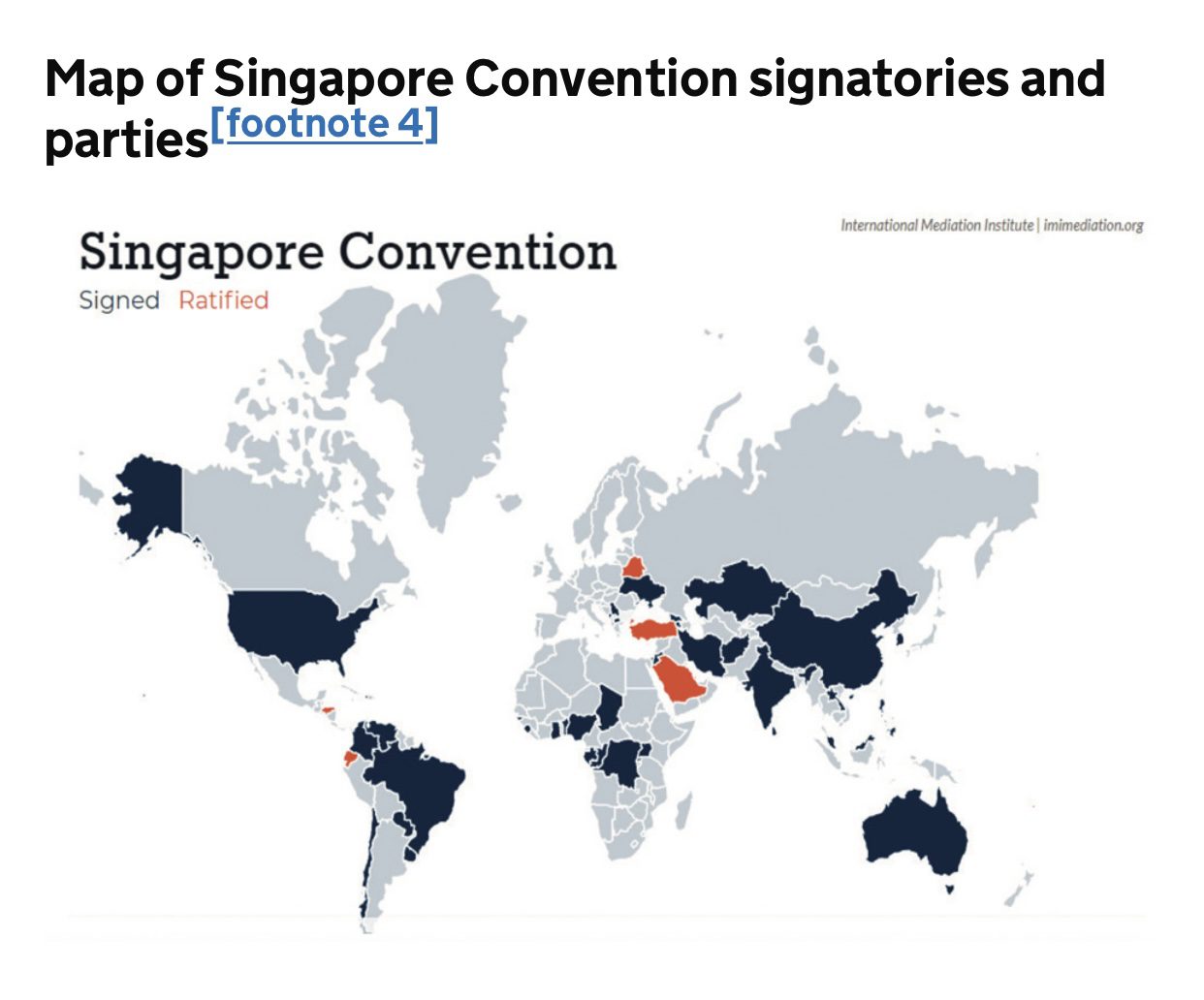
Who has signed the Singapore Convention?
Parties
There are currently 9 parties to the Convention (Correct at time of publication). These are Fiji, Qatar, Saudi Arabia, Belarus, Ecuador, Honduras, Turkey, Georgia and Singapore. It is noted that Honduras ratified the Convention on 2 September 2021 and so the Convention will come into force for Honduras on 2 March 2022. The Convention will similarly come into force for Turkey, who ratified it on 11 October 2021, and Georgia, who ratified it on 29 December 2021, on 11 April 2022 and 29 June 2022 respectively.