
Reflections on Michel Kallipetis KC’s Lecture on Mediation Privilege & Confidentiality
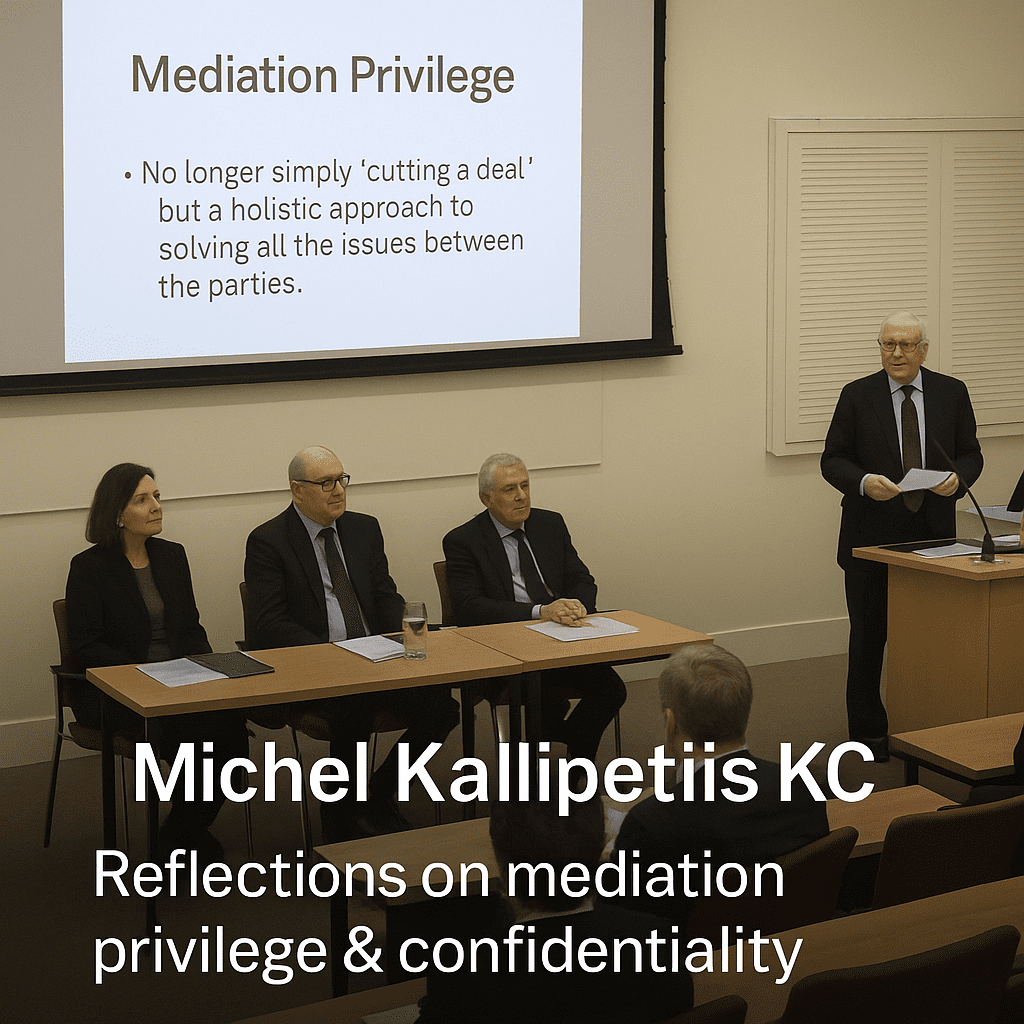
Yesterday evening I had the pleasure of attending the Civil Mediation Council’s inaugural Academic Lecture, hosted in partnership with UCL’s Centre for Dispute Resolution. The speaker was Michel Kallipetis KC, who delivered a profound and timely examination of why mediation privilege and confidentiality must now be formally recognised by the courts.
For over 25 years, the English courts have urged parties to resolve disputes by alternative means. As one slide reminded us:
“For a quarter of a century the English Courts have urged parties to resolve their disputes by alternative means… after Churchill, the court has the power to order even unwilling parties to mediate.”
Yet, as mediation expands into every field of dispute resolution, the legal foundations supporting it—particularly confidentiality—remain uncertain.
The Mediator’s Unique Role
Kallipetis emphasised that mediation is far more than “assisted without-prejudice negotiation.” Quoting from his slides:
“The mediator encourages parties to share with him information which the party does not want the other to know, and which the mediator agrees to keep secret.”
“The ability of a mediator to receive mediation secrets… and use that knowledge to assist the parties towards settlement, is unique to mediation.”
It was compelling to hear him describe situations where, because parties felt truly protected, they disclosed fears, hopes, vulnerabilities, and even concessions—insights that enabled him to guide them to resolution. Without confidentiality, these conversations could never happen.
Lord Briggs’ Warning
He also highlighted judicial concern, quoting Lord Briggs:
“If confidentiality is limited only to the without-prejudice principle… mediation will lose one of its main attractions as a dispute resolution process.”
This encapsulates the risk: if mediation is treated as merely another form of settlement negotiation, its transformative potential is undermined.
Do we need a distinct mediation privilege?
Another slide captured the heart of the debate:
“No longer simply ‘cutting a deal’ but a holistic approach to solving all the issues between the parties.”
“The balance: (1) the public interest in determining disputes on all available evidence, and (2) the need to encourage full engagement in mediation without fear of later use in litigation.”
Kallipetis argued persuasively that mediation today is more sophisticated, psychologically nuanced, and relational than when the Woolf Reforms were introduced. Its protection must evolve accordingly.
A powerful analogy: The Christmas Truce
To illustrate the extraordinary things people can achieve when hostility pauses and trust briefly takes root, he invoked the Christmas Truce of 1914, where soldiers emerged from their trenches, laid down arms, and spoke to one another as human beings.
Mediation, at its best, creates that same temporary space—where adversaries can meet in honesty, acknowledge each other’s humanity, and move towards peace. But this can only happen when parties feel entirely safe in what they say.
Why this matters now
As the courts increasingly encourage or compel mediation, the need for clarity is pressing. The system cannot rely on assumptions about confidentiality that vary from case to case or jurisdiction to jurisdiction.
One slide captured the diversity of international approaches:
“Some jurisdictions regard mediation privilege as absolute… others permit courts to admit evidence ‘in the interests of justice.’”
If mediation is to retain its strength, the law in England & Wales must provide certainty—not ambiguity—about what can and cannot be used outside the mediation room.
A superb and thought-provoking event
The evening was an excellent contribution to the evolving conversation around mediation law and practice. My thanks to the Civil Mediation Council, UCL, and Michel Kallipetis KC for an inspiring and intellectually rich lecture.
Hashtags
#Mediation #Confidentiality #MediationPrivilege #CivilMediationCouncil #ADR #DisputeResolution #UCL #LegalProfession #Mediators #AccessToJustice #HolisticResolution #LawReform